Home Blog Page 28

Getting Started With Content Networking

In our digital age, networking has taken on an entirely new dimension. With the advent of content networking, connections are forged, and relationships are built not just based on personal encounters but also on the value-driven content that individuals and businesses put out there. Content networking is a strategy that encompasses creating, publishing, and distributing valuable content to your target audience to build strong relationships, improve engagement, and boost your business performance. Below, we delve into how you can get started. Keep reading to learn more.

Understanding the Concept of Content Networking

A business team in a conference room discussing how they can get started with content networking.

Content networking is a method that combines aspects of content marketing and networking. It involves using valuable, relevant, consistent content to attract and engage a clearly defined audience to drive profitable customer action. Instead of explicitly selling your product or service, content networking adds value to your audience’s life by educating, informing, or entertaining them. When done right, content networking allows you to build a loyal audience, deepen your connections, enhance your brand value, and drive growth for your business.

The Art of Creative Content Creation

Effective content networking begins with crafting compelling content. The type of content you create will depend largely on your audience and the platforms you’re utilizing. It could be blog posts, articles, podcasts, videos, infographics, webinars, or social media updates. Regardless of the format, it’s critical that your content provides value to your audience. But above all, it should be unique and authentic.

To consistently create engaging content, you’ll need a deep understanding of your target audience. This requires thorough market research, including identifying their needs, preferences, and pain points. The better you understand your audience, the easier it will be to create content that resonates with them.

Moreover, understanding search engine optimization (SEO) principles is crucial as it enables your content to reach a larger audience by increasing its visibility in search results. Using appropriate keywords, optimizing images, and including internal links are some SEO strategies to boost your content’s search ranking.

Maintaining Consistency and Building Relationships

A team of employees around a table discussing how to implement content networking.

In content networking, consistency is key. Consistently delivering valuable content increases your reliability and positions you as an expert in your field. It also keeps your brand at the top of your audience’s mind, making building brand loyalty and fostering a sense of community easier. Plan a regular publishing schedule and stick to it—even when you don’t see immediate results, remember that consistency pays off in the long run.

However, content networking is not just about pushing out content. It’s equally important to build relationships with your audience. Connect with them on a personal level, listen to their feedback, and show that you value their opinions. And it’s not just the audience; networking with other industry experts, influencers, and thought leaders can open up new opportunities for collaboration and learning.

Lastly, it’s important to measure and evaluate the effectiveness of your networking efforts constantly. With the help of analytics tools, track the performance of your content in terms of engagement, reach, and conversions. Use these insights to refine your strategy and make necessary adjustments to achieve your desired results.

Content networking is a powerful strategy that can significantly boost your digital presence. It helps you engage with your audience on a deeper level and positions you as a thought leader in your field. With a deep understanding of your audience, a knack for creative content creation, an effective social media strategy, and a commitment to consistency, you’re on your way to a successful content networking journey.

The Best Marketing Strategies for a Business

Developing successful marketing strategies is an important task for the overall success of a business. However, knowing which marketing strategies to use to grow your business can be challenging.

Best Marketing Strategies for a Business

The good news is that experts have suggested tried-and-tested marketing strategies. Some of these marketing strategies are the following:

  1. Start Blogging

If done well, blogging is among the best ways to drive traffic to your site. As a matter of fact, marketers report that utilizing blogs effectively can get 70% more leads than people who don’t.

In order to succeed in blogging, you have to find the right niche, concentrate on quality over quantity, and create promotion strategies before you start writing. But don’t stop at that. Use professional templates to design your blog and promote it.

  1. Distribute Flyers

Well-thought-out flyer campaigns are an effective strategy for marketing, especially if you use them with other methods of advertising. They are an affordable and simple way to reinforce the name of your brand in the public sphere.

Using flyer distribution service is an effective strategy for a few reasons, such as better read rates and low costs. You may give them out at public places, and local events, and even mail them to your audience. Either way, you will increase visibility and generate more positive results.

  1. Make Tutorial Videos

Among the effective ways of getting the word out is to consider creating tutorial videos. Teach individuals something helpful, take them through the process, and hold their hands.

Today, YouTube remains the second biggest search engine after Google. When someone wants to learn things, they will head there. So consider asking yourself what you can reach in business, which helps customers solve their pain points.

  1. Use Social Media

Having social media platforms will not just enable you to share updates and control your message freely. It will also enable you to build a community around your own product, company, and brand.

As an effective and free platform to be active, using social media is the best way to get feedback, address customer service issues, and build content. Most customers also look at social media platforms to determine whether they may trust your company or brand to check reviews.

  1. Take Advantage of SEO

Beyond creating a good website, SEO is probably the most effective strategy for marketing your small business. SEO (search engine optimization) refers to the process of optimizing content and websites for end users or websites to find your business easily.

Normally, the more you rank on search engines, such as Google, the more you are likely to drive traffic to your site. With more than 40% of traffic coming from a local course, clients looking for services are more likely to get your business in Google’s results. You may SEO by optimizing your site, requesting reviews, and creating a GMB.

In a Nutshell

More likely, you may find that conversion rates on the marketing is low. Even successful campaigns can measure converted sales and leads in the 15% to 25% range. This will help you to shatter illusions about success and provide you with an opportunity for improvement.

ONDC Connector Changes How E-Commerce Works By Using New Technology

The Open Network for Digital Commerce (ONDC) Connector has risen to prominence as the designer of frictionless commercial exchanges in a world dominated by technology. ONDC Connector, which has the support of the Indian government, ushers in a new age of linked e-commerce and has the potential to revolutionize the way consumers and businesses interact in the online market.

The days of lonely Internet purchases are over. The ONDC Connector proves to be a digital hub that connects several online marketplaces, eliminating roadblocks and easing the flow of business. When it comes to facilitating business transactions across several systems and programs, this innovative technology goes above and beyond the norm.

Recent Advances by ONDC

The innovative technology behind ONDC makes it easier for buyers and sellers to complete transactions on any platform. It serves as a conduit for online commerce by bridging the gap between different online marketplaces and making cross-platform purchases simple.

ONDC has built a thriving ecosystem that encourages participation and fair competition among its 37 members, which includes industry heavyweights such as PhonePe, Hindustan Unilever, and ITC.

The development of the platform has been very astounding. As evidence of its dedication to promoting economic growth for companies of all sizes, ONDC boasts a vibrant network of over 1,00,000 merchants and the involvement of more than 45 organizations in 273 cities. The growth of the platform has revolutionized the way companies in India conduct their operations and work together in the digital sphere.

ONDC levels the playfield for businesses

The potential of ONDC to level the playing field for MSMEs and small merchants is one of its most striking qualities.

ONDC takes use of open protocols to streamline connections across industries including transportation, retail, restaurants, hotels, and more. Businesses of all sizes will benefit from this program since it will encourage new ideas and keep the playing field level.

“ONDC is at the forefront of assisting brands to thrive in the digital space,” said Arishekar N, senior director of marketing and growth. SellerApp assists Shopify merchants in joining the ONDC network in order to “ensure seamless integration, streamline operations, access a wider customer base, and benefit from the network.”

SellerApp is a data analytics firm that facilitates participation in the ONDC network for e-commerce merchants and consumer packaged goods (CPG) firms. The firm’s seamless interfaces provide customers with the market knowledge and business monitoring tools necessary to realize their full e-commerce potential.

The integration process to connect your Shopify store

To integrate their Shopify shop with the ONDC platform, businesses may use a seller application like SellerApp.

Connect Your Shopify Store: Connecting your Shopify business to the SellerApp marketplace is the first step. With this groundwork in place, your online shop will be ready to take full use of SellerApp’s powerful features.

Update the Product Catalog: With SellerApp, you can easily sync your product catalog across both platforms with no loss of data quality. Your product inventory management will be greatly facilitated by this synchronization.

Efficient Inventory Management: With SellerApp, you can manage your stock in ways never before possible. Keep an eye on supplies, control variations in products, and get instantaneous feedback to make inventory management a breeze.

Streamlined Order Processing: Order processing is simplified using SellerApp. Take care of order processing, monitor shipping, and improve your customers’ experiences with regular updates.

Performance Insights and Reports: In addition to seamless connection, SellerApp also provides insightful performance data and comprehensive reporting. You may improve your company tactics with the aid of these analytics since they enable you to make well-informed choices.

ISRO Will Launch Aditya-L1 To Study Sun After Chandrayaan-3 Success

India’s space agency has scheduled its next mission Aditya-L1, which would include solar research, after the success of the Chandrayaan-3 moon landing.

This week, as scientists and crew celebrated the successful completion of the moon mission, ISRO announced to reporters at its satellite command center that the Aditya-L1, India’s first space observatory for solar research, is getting ready for launch at the country’s main spaceport in Sriharikota.

ISRO chairman S. Somanath has said, “We are planning to launch in the first week of September.”

What plans does Aditya-L1 have?

The spacecraft is India’s first solar probe in orbit, and its name comes from the Hindi word for the sun. The “auroras” observed from Earth are really caused by solar winds, which scientists want to learn more about.

In the long run, the mission’s data might provide light on how the sun affects Earth’s climate.

To better understand where solar wind comes from, scientists have recently reported that the European Space Agency/NASA Solar Orbiter spacecraft has discovered multiple very modest jets of charged particles emitted intermittently from the corona, the sun’s outer atmosphere.

What is its range?

The PSLV is India’s most powerful launch vehicle, and it will carry the Aditya-L1 spacecraft on its 1.5 million kilometer journey to the sun’s atmosphere in roughly four months.

The spaceship will save fuel by traveling to a “parking lot” in space, where items prefer to remain due to balancing gravitational pulls.

The Italian-French mathematician Joseph-Louis Lagrange is honored by the naming of these locations as Lagrange Points.

What is the price tag for this endeavor?

The budget for the Aditya-L1 mission was approved in 2019 at about Rs. 380 crore (about $46 million). There has been no confirmed price increase from ISRO.

Executives and planners believe India’s newly privatized space sector would benefit from the Indian Space Agency’s (ISRO) reputation for cost competitiveness in space engineering.

Costing close to Rs. 620 crores (almost $75 million), the Chandrayaan-3 mission successfully landed a spacecraft on the lunar south pole.

WhatsApp New HD Video Sharing Features For Android Users

Just days after the Meta-owned messaging network added functionality for transmitting high-resolution pictures, the WhatsApp HD video sharing feature has began trickling out to users on Android. All movies transmitted using WhatsApp were previously compressed, resulting in inferior quality for the receiver. The messaging software will now provide users the option to share selected films in high definition, which has clear advantages in terms of quicker file delivery and cheaper bandwidth and storage consumption.

An HD indicator appears at the top of the screen when choosing a video to share with contacts in the latest version of WhatsApp for Android (2.23.17.74), which started rolling out on Thursday. By default, WhatsApp only supports sending and receiving movies at 480p, but when this is toggled to “on,” the app will send and receive films in 720p.

After upgrading to the most recent version of WhatsApp for Android, the functionality became accessible on the phones of the Gadgets 360 team. There has been no announcement on when the feature, which is now under beta testing, would become available to users on the stable version of WhatsApp for iOS.

It’s important to note that sending a video at a higher quality requires the user to change the option each time. By default, the app will only deliver movies at a “standard” quality of 480p, which is very low-resolution in comparison to today’s smartphones with full-HD and quad-HD screens. This was probably done to prevent WhatsApp media from accumulating to an unmanageable size on a user’s phone.

After installing the most recent version of WhatsApp for Android, you may follow these instructions to transmit a high-definition video. Remember that it’s possible the function won’t be accessible to you.

WhatsApp’s HD video-sending instructions

Start a new WhatsApp conversation, then go to the attachment icon > Gallery.

To see a preview of the video before sending it, find it and touch on it.

You may access HD mode by clicking the icon that appears to the left of the sticker, text, and drawing tools at the top of the screen.

Choose the higher HD resolution, take note of the larger file size, and then press the Done button.

After making any necessary adjustments, hit the share button in the lower right.

New Realme Buds Air 5, Buds Air 5 Pro Launched With 50dB ANC And IPX5 Rating

Realme released two new models of truly wireless stereo (TWS) earbuds in India: the Realme Buds Air 5 and the Buds Air 5 Pro. With the release of the Realme 11 5G and Realme 11X 5G, the business also introduced its newest TWS audio products. The in-ear headphones include an active noise cancellation (ANC) function that may cut ambient noise by as much as 50 decibels. There are 12.4mm drivers in the standard Realme Buds Air 5, whereas 11mm drivers can be found in the Buds Air 5 Pro.

Realme Buds Air 5 and Realme Buds Air 5 Pro features and Specs

Both the Realme Buds Air 5 and Realme Buds Air 5 Pro have an oval-shaped charging case and tout an active noise canceling (ANC) function that can decrease ambient noise by up to 50dB at 4000Hz. There are two 11mm coaxial drivers and a 6mm tweeter in the Buds Air 5 Pro. In contrast, the standard Realme Buds Air 5 use 12.4mm drivers.

The Buds Air 5 are wireless earbuds that, according to the company, have a latency rate of up to 45 ms, while the Realme Buds Pro are wireless headphones that, supposedly, have a latency rate of up to 40 ms. The Buds Air 5 Pro provide Hi-Res audio, while the regular model has Dolby Atmos technology. They also include 360-degree spatial audio effects and support the LDAC Bluetooth codec.

The latest earbuds from Realme include Bluetooth 5.3 and are compatible with Google Fast Pair. They can be personalized with the Realme Link app and have touch controls for easy access to music and noise cancelling. Additionally, the new Realme Buds Air 5 have a dust and water resistant rating of IPX5.

Furthermore, the Realme new Buds Air 5 have a combined battery life of up to 38 hours (including the time spent charging the case). However, the Buds Air 5 Pro, the top model in the new series, are advertised as being capable of 40 hours of listening time on a single charge when used in conjunction with the charging case. According to the manufacturers, just 10 minutes of charging time is required for both models to provide seven hours of music listening time.

Realme Buds Air 5 and Realme Buds Air 5 Pro Price and Availability

In India, the cost of the Realme latest Buds Air 5 is Rs. 3,699. They are on sale on August 26 and come in Arctic White and Deep Sea color choices.

However, the Realme Buds Air 5 Pro may be purchased for Rs. 4,999. They’ll be available for purchase on August 29 in Astral Black and Sunshine Blue. Both sets of headphones will be sold at major retailers and online marketplaces including Flipkart and Realme website.

New Realme 11 5G, Realme 11X 5G Launched With MediaTek Dimensity 6100+ SoC

On Wednesday, August 23rd, Realme introduced the Realme 11 5G and the Realme 11X 5G in India. The new phones were introduced with the truly wireless stereo (TWS) earbuds Realme Buds Air 5 and Realme Buds Air 5 Pro. Realme’s 11 5G and 11X 5G both have a MediaTek Dimensity 6100+ SoC and a 120Hz refresh rate screen. The main sensor on the Realme 11 5G, which may be as high as 108 megapixels, is part of a twin camera setup on the device’s back. The Realme 11X 5G, on the other hand, has a dual 64-megapixel camera setup on the back.

Realme 11 5G features and specs

The Realme 11 5G has a 6.72-inch, full-HD+ (1,080 x 2,400 pixel), Samsung AMOLED display, runs on Android 13, and has a 120Hz refresh rate and a 240Hz touch sampling rate. Under the hood, you’ll find a 6nm MediaTek Dimensity 6100+ SoC and 8GB of RAM. The device’s Dynamic RAM Expansion (DRE) function may make use of spare space to increase the available amount of virtual memory. This feature allows for the maximum amount of RAM to be raised to 16GB.

The primary camera on the Realme 11 5G is a 108-megapixel Samsung ISOCELL HM6 sensor with an f/1.75 aperture, and it’s joined by a 2-megapixel depth sensor. Its 16-megapixel camera with f/2.45 aperture is great for taking photos and video chatting with friends.

The Realme 11 5G features up to 256GB of internal storage. There is a microSD card slot for adding up to 2TB to the available internal storage. A fingerprint reader is located on its side for further security. It supports twin SIM cards with dual standby, as well as 4G LTE, dual-band Wi-Fi, Bluetooth 5.2, GPS, A-GPS, and a USB Type-C connection for transferring data.

The Realme 11 5G has a 5,000 mAh battery and can be charged at 67W with the help of SuperVOOC. It is claimed that it takes just 17 minutes to fully charge the battery using this rapid charging technique.

Realme 11X 5G Features and specs

The Realme 11X 5G has a 6.72-inch full-HD+ (1,080×2,400 pixel) AMOLED display with up to 120Hz refresh rate and up to 240Hz touch sampling rate, and it operates on Android 13 with realme UI 4.0 on top. The maximum brightness of the screen is rated at 550 nits, and the screen-to-body ratio is 91.40 percent. It has a MediaTek Dimensity 6100+ SoC with octa-core processing and up to 16GB of RAM. Memory may be increased to a maximum of 16GB by using the Dynamic RAM feature.

The Realme 11X 5G has a 64-megapixel main sensor with an f/1.79 lens and a 2-megapixel portrait sensor in its dual-camera arrangement on the back. The phone has an 8-megapixel front-facing camera sensor with an f/2.05 lens, making it ideal for taking selfies and video chatting.

The Realme 11X 5G offers a whopping 128GB of internal storage space. The phone has a USB Type-C connector, as well as support for 5G networks, 4G LTE networks, Wi-Fi, Bluetooth 5.2, GPS/A-GPS, and more.

The new Realme 11X 5G has a 5,000mAh battery with support for 33W SUPERVOOC rapid charging. It has dimensions of 165.7 x 76 x 7.89 mm and a weight of 190 g.

Realme 11 5G, Realme 11X 5G Price and Availability

The base model of the Realme 11 5G, with 8GB of RAM and 128GB of storage, costs Rs. 18,999. Prices start at Rs. 19,999 for the 8GB RAM + 256GB storage variant. It is on sale on August 29 and is available in Glory Gold and Glory Black.

On the other hand, the base model Realme 11X 5G with 6GB of RAM and 128GB of storage costs at Rs. 14,999. For Rs. 15,999, you can get the model with 8GB of RAM and 128GB of storage space. Beginning on the 30th of August, you may purchase it in your choice of Midnight Black or Purple Dawn.

Both smartphones will be available for purchase at major retailers and online at Realme.com and Flipkart. Flipkart’s inaugural offer for using SBI and HDFC credit cards is an immediate discount of up to Rs. 1,500.

WhatsApp Developing Shortcut To Send View-Once Images And Videos On Latest Beta

You may now send photos and videos to other WhatsApp users that can only be seen once, and the app’s developers are working on an update to the user interface to make sending these messages even simpler. WABetaInfo, a feature tracker for WhatsApp, claims that soon the app would let users easily share a picture or video from their camera roll with only a few clicks. The fact that WhatsApp is developing support for sending various message kinds as view-once messages implies that it may replace traditional methods of sending such communications.

According to a report by WABetaInfo, the newest version of WhatsApp beta contains a feature that will allow users to swiftly send a view-once message by clicking and holding the send button instead of touching the “1” symbol in the caption box when transmitting an image or video. Above the send button, users will see a drop-down menu with only one option: Send as view once.

This functionality, which was discovered on the Android 2.23.18.3 beta version of WhatsApp, is not yet available for testing on the most recent beta versions of the program for iOS and Android. The upgrade will likely be sent to beta testers first, before being pushed out to the general public by the corporation. Currently, only photos and videos may be sent as view-once messages; GIFs are not allowed.

If you have opted in to receive beta updates, you will see a notification pop up above the send button in WhatsApp’s image/video sending preview once the functionality is released to beta testers. Press and hold to send as a view once message shows. WABetaInfo suggests following this with the choice to Send as view once.

The “1” symbol in the caption area may be removed if the feature tracker is correct and WhatsApp’s view once feature is updated to the new design. Previous reports have indicated that the corporation is aiming to expand view-once message capability to include audio (voice notes) and text messages.

A recent rumor claims that WhatsApp has started testing a new feature that would let users create stickers using AI. Stickers may be created on the spot when users enter phrases like “cat laughing on a skateboard” into the app’s prompt box. The feature tracker also reveals that WhatsApp Web now supports password protection for user conversations.

Chandrayaan 3 ‘Vikram’ And ‘Pragyan’ Will Conduct Lunar Surface Experiments

The Chandrayaan 3 Lander ‘Vikram’ and rover ‘Pragyan’ are set to touch down on the Lunar surface. They will have their work cut out for them, and this is what they will do once they have arrived to Earth’s sole natural satellite.

The Chandrayaan 3 Lander may land on the moon at a designated spot, releasing the Rover to explore the area while collecting samples for an on-the-spot chemical analysis.

The Chandrayaan 3 Both the Lander and the Rover deliver scientific payloads to the moon’s surface for use in conducting research. The primary goal of the Propulsion Module (PM) was to transport the Lander Module (LM) from the point of injection by the launch vehicle to the final lunar 100 km circular polar orbit and then detach the LM from the PM.

In addition, the PM carries a research payload called the Spectro-polarimetry of Habitable Planet Earth (SHAPE) payload, which will analyze spectral and Polari metric data of Earth from a lunar orbit.

Following are the major specifications of the Chandrayaan 3 lander and rover

Including Rover, the lander weighs a total of 1749.86 kg.

its mission duration is one Lunar day (14 Earth days).

It has four separate scientific payloads.

The near-surface plasma (ions and electrons) density and its variations over time will be measured by the Radio Anatomy of Moon Bound Hypersensitive Ionosphere and Atmosphere (RAMBHA) mission.

The thermal characteristics of the lunar surface close to the polar zone will be measured by the Chandra Surface Thermophysical Experiment (ChaSTE).

Measurements from the Instrument for Lunar Seismic Activity (ILSA) will be used to determine the composition of the lunar crust and mantle around the landing site.

To learn more about the Moon and its orbit, NASA has developed a passive experiment called the Laser Retroreflector Array (LRA).

In addition to the Lander Hazard Detection & Avoidance Camera, the LRA will contain a total of seven sensors.

The six components of a Lander are the Lander leg, the Rover ramp (primary and secondary), the Rover, the Integrated Landing System Assembly, the Rambha and Chaste payloads, the Umbilical connection protection mechanism, and the X- Band antenna Rover.

Quantitative and qualitative elemental analysis using a Laser Induced Breakdown Spectrometer (LIBS) Propulsion Module

To better comprehend the lunar surface, we may use LIBS to determine its chemical composition and, by extension, its mineralogical composition.

The Alpha Particle X-ray Spectrometer (APXS) will analyze the lunar soil and rocks around the landing site to identify their elemental makeup (including magnesium, aluminum, silicon, potassium, calcium, titanium, and iron).

New Redmi A2+ Launched With 4GB RAM And 128GB Storage

The Redmi A2+ now offers more memory and storage options in the Indian market. The smartphone was first introduced in India with the Redmi A2 in March of this year. It debuted with support for 64GB of storage and 4GB of RAM. The new Redmi A2+, on the other hand, has more storage space but the same amount of RAM. It has a MediaTek Helio G36 SoC and a 5,000mAH battery, and it can stay on standby for up to 32 days, according to the manufacturer.

Redmi A2+ Features and Specs

The HD+ (1600 x 720) LCD screen on the Redmi A2+ has a touch sampling rate of 120 Hz and is 6.5 inches in size. MediaTek’s Helio G36 system-on-chip (SoC) and as much as 4GB of RAM provide the juice for this phone. It also has memory fusion technology, which lets you utilize up to 3GB of storage space for more RAM. The smartphone operates on Android 13 and has dual SIM card compatibility.

The optics on the Redmi A2+ consist of an 8-megapixel main sensor and a QVGA camera supported by artificial intelligence. There’s a 5-megapixel camera up front for taking pictures and making video calls.

The device have a 5,000mAh battery and charger in the box. The company behind the smartphone claims that it can last 32 days without charging and make 32 hours of phone calls before needing to recharge. An audio jack of 3.5 millimeters in size is included.

Redmi A2+ Price and Availability

Mi.com now sells a Redmi new model A2+ with 4GB of RAM and 128GB of storage for Rs. 8,499. In addition to Amazon and MI.com, you can buy it via authorized Xiaomi retailers. The model with 4GB RAM and 64GB storage is presently available for Rs. 7,999.

In India, you can get a Redmi A2+ in three different colors: Classic Black, Sea Green, and Aqua Blue.

VMware And NVIDIA Allow Enterprise Generative AI

To better prepare the hundreds of thousands of businesses that use VMware’s cloud infrastructure for the age of generative AI, VMware Inc. (NYSE: VMW) and NVIDIA (NASDAQ: NVDA) today announced the extension of their strategic relationship.

With the help of NVIDIA and VMware’s Private AI Foundation, businesses will be able to deploy generative AI applications like chatbots, virtual assistants, search engines, and summarization tools.  The platform will be a turnkey AI-optimized solution based on VMware Cloud Foundation and including NVIDIA accelerated compute and generative AI software.

VMware CEO Raghu Raghuram recently said, “Generative AI and multi-cloud are the perfect match.” “Client data resides in the cloud, on the edge, and in the customer’s own data centers. Working with NVIDIA, we’ll alleviate companies’ worries about data privacy, security, and control so that they may safely operate generative AI workloads in close proximity to their data.

According to NVIDIA CEO and founder Jensen Huang: “Enterprises everywhere are racing to integrate generative AI into their businesses.” Using their own data and bespoke applications, hundreds of thousands of clients in industries like as finance, healthcare, manufacturing, and more will have access to the whole stack of software and computing that our company and VMware are now collaborating on.

Full-Stack Computing to Supercharge Generative AI

Companies want to speed up the time it takes to reap the advantages of generative AI applications by simplifying the process of creating, testing, and releasing them. McKinsey predicts that generative AI might boost global GDP by as much as $4.4 trillion per year.(1)

Businesses can take advantage of this capability with VMware Private AI Foundation and NVIDIA by tailoring large language models, creating more secure and private models for internal use, providing generative AI as a service to their users, and safely running large-scale inference workloads.

With the platform’s built-in AI technologies, businesses will be able to efficiently use validated models based on their own data. The platform will be based on NVIDIA AI Enterprise and VMware Cloud Foundation, and its intended advantages would include:

With an architecture that protects sensitive information and allows only authorized users access, businesses will be able to deploy AI services close to their data without worrying about compromising security.

From NVIDIA NeMoTM through Llama 2 and beyond, as well as on major OEM hardware configurations and, in the future, on public cloud and service provider solutions, businesses will have a broad variety of options for building and running their models.

NVIDIA-accelerated infrastructure has been shown in recent industry benchmarks to achieve performance levels comparable to, and in some instances even higher than, bare metal.

In order to expedite the fine-tuning and deployment of generative AI models, GPU scaling improvements in virtualized settings will allow AI workloads to scale over up to 16 vGPUs/GPUs in a single virtual machine and across several nodes.

In order to save expenses, we will pool all of our computing resources (CPUs, GPUs, and DPUs) and use them as effectively as possible to benefit all of our teams.

In order to facilitate direct I/O transfer from storage to GPUs without involving the CPU, VMware vSAN Express Storage Architecture will provide performance-optimized NVMe storage and enable GPUDirect® storage via RDMA.

To further facilitate the execution of multi-GPU models without inter-GPU bottlenecks, vSphere has been deeply integrated with NVIDIA’s NVSwitchTM technology.

Time to Value and Rapid Deployment are Made Possible by the vSphere Deep Learning VM Images and Image Repository, which provide a solid turnkey solution image with pre-installed frameworks and performance-optimized libraries.

Included in NVIDIA AI Enterprise, the platform’s operating system, is the NVIDIA NeMo cloud-native framework, which facilitates the creation, personalization, and remote deployment of generative AI models by businesses of any size. NeMo provides businesses with a simple, inexpensive, and quick solution to implement generative AI by combining customisation frameworks, guardrail toolkits, data curation tools, and pretrained models.

TensorRT for Large Language Models (TRT-LLM) speeds and improves inference performance on the most recent LLMs on NVIDIA GPUs, therefore NeMo relies on it when implementing generative AI in production. Businesses will be able to use their own data in conjunction with NeMo and VMware’s hybrid cloud architecture to create and operate their own generative AI models.

At VMware Explore 2023, NVIDIA and VMware will showcase how corporate developers can leverage the NVIDIA AI Workbench to remotely configure and deploy production-grade generative AI in VMware systems using community models like Llama 2 from Hugging Face. The VMware Private AI Foundation has widespread ecosystem support. Dell Technologies, HPE, and Lenovo will be among the first to offer systems that supercharge enterprise LLM customization and inference workloads with NVIDIA L40S GPUs, NVIDIA BlueField®-3 DPUs, and NVIDIA ConnectX®-7 SmartNICs, all of which are supported by the NVIDIA VMware Private AI Foundation with NVIDIA.

When compared to the NVIDIA A100 Tensor Core GPU, the NVIDIA L40S GPU delivers up to 1.2x faster generative AI inference performance and up to 1.7x faster training performance.

Accelerating, offloading, and isolating the massive computing load of cloud-native AI services like virtualization, networking, storage, and security is made possible by NVIDIA BlueField-3 DPUs.

Some of the most demanding AI workloads in the world will benefit greatly from the intelligent, accelerated networking provided by NVIDIA ConnectX-7 SmartNICs in the data center.

VMware and NVIDIA’s 10-year cooperation continues with the launch of the VMware Private AI Foundation. Through their collaborative engineering efforts, VMware’s cloud infrastructure is now capable of running NVIDIA AI Enterprise at bare-metal levels of performance. In addition, VMware Cloud Foundation’s resource management and infrastructure flexibility are a win-win for both companies’ respective clients.  

AI Disrupts EdTech: Transforming Education with Cutting-Edge Technology

Education has undergone a remarkable transformation, evolving from traditional classrooms with chalkboards and textbooks to the dynamic realm of EdTech (Education Technology). This digital landscape is filled with tools and platforms, ranging from online learning platforms to interactive digital content, virtual reality simulations, learning management systems and adaptive learning software.

Students worldwide are embracing the EdTech revolution, with 81% of college students in the United States reporting that digital learning technology has boosted their grades. However, a new disruptor in town is set to revolutionize the education sector once again—Artificial Intelligence or AI.

AI’s impact on the education industry has been significant and its potential is yet to be fully realized. In fact, 99.44% of higher education institutions in the United States believe that integrating artificial intelligence into education will be essential for their competitiveness in the next three years. This belief is well-founded since the education industry has traditionally followed a one-size-fits-all approach to imparting knowledge. With the advent of EdTech and the incorporation of AI, personalized learning can be achieved in the truest sense.

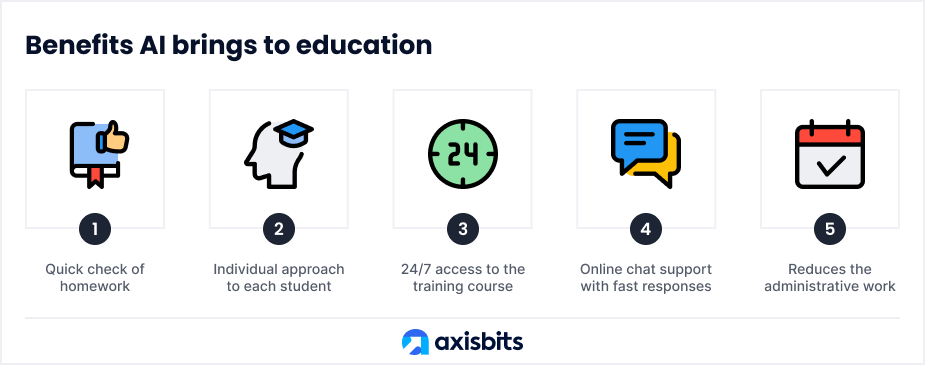
Benefits of AI in Educational Technology

What exactly is the potential of AI in the education sector? How can AI revolutionize education? Let’s explore.

Upgrading EdTech with AI: Where AI Fits In

AI has the ability to enhance various aspects of education. Let’s take a closer look at the most crucial EdTech technologies and strategies where AI can make a significant impact.

Virtual Reality

Virtual Reality (VR) has already been instrumental in creating immersive learning experiences, simulating real-world scenarios such as historic events, scientific experiments and complex machinery. With AI entering the picture, these experiences can become even more personalized and engaging. AI and VR together have the potential to bridge skill gaps and upskill the workforce of the future. For instance, AI and VR can create virtual workshops, apprenticeships and internships, providing learners with opportunities to gain real-world experience and develop valuable skills within a simulated environment.

Chatbots

While chatbots have been around for a while, the integration of AI has made them more advanced than ever. The education sector is one of the top five industries benefiting from chatbots. Learners can interact with chatbots designed to assist them in understanding specific topics and solving problems. Chatbots can help manage assigned tasks, monitor learner progress, aid in assessment and provide rapid communication.

Smart Content

AI empowers educators to create intelligent content that is both engaging and enjoyable for students. When lessons are designed with customization options, study guides and up-to-date content, learners are more likely to adopt them quickly. Visual representations are particularly effective and AI can help provide study material with visualizations and simulations tailored to match learners’ preferred learning styles.

Personalized Education

AI’s role in education is not to replace teachers but to enhance the educational experience for both teachers and students. Integrating AI systems can provide personalized learning experiences based on individual students’ needs, strengths and weaknesses. Teachers can offer customized content and receive feedback through data analysis and algorithms. This approach allows students to learn at their own pace and focus on areas that require more attention.

The Future of Education Is AI

According to reports, the global market size of AI in Education reached $1.82 billion in 2021 and is projected to grow at a CAGR of 36% from 2022 to 2030. The increasing investments in AI and EdTech by both the private and public sectors and the evolving technology landscape demonstrate the growing demand for Artificial Intelligence in the education sector. Additionally, the impact of COVID-19 has further accelerated the adoption of online education, with 51% of faculty in the United States expressing increased confidence in this mode of learning.

A picture containing text, screenshot, font, brand

Description automatically generated

As the use of artificial intelligence continues to expand, tech companies are partnering with universities to introduce new training formats to nurture AI talent. AI is just one of the revolutionary technologies disrupting the education sector. If you want to explore all the industry trends and technologies shaping EdTech, be sure to check out our comprehensive article covering the Top Education Technology Trends of 2023!